28,000 Structures, 3,000 Acres: Inside Kampala’s Railway Clearance Crisis
The Sudden Knock — A Community Facing Homelessness
For decades, disused and overgrown railway lines running through urban Kampala and Wakiso functioned as local access roads and informal neighborhood hubs. Many of these colonial-era metre-gauge railway tracks fell silent in the 1980s and 1990s, with steel rails vandalized or stolen for scrap. Families built homes, opened storefronts, and rented rooms in long-standing settlements along dormant corridors such as Kampala–Ndeeba–Nateete–Kyengera–Bujuuko and Kampala–Mukono–Jinja–Malaba.
However, on October 12, 2026, the Uganda Railways Corporation (URC), under a Cabinet directive and backed by security forces, launched a major nationwide eviction drive. The state's objective is to clear right-of-way land to rehabilitate the metre-gauge railway (MGR) and secure land for the planned Standard Gauge Railway (SGR). Across the country, over 28,000 structures occupying 3,000 acres of URC's 20,000-acre estate were marked for immediate clearance. For thousands of working-class families, decades of neighborhood life transformed into an overnight struggle against sudden displacement.
Self-Demolition — Tearing Down One’s Own Home
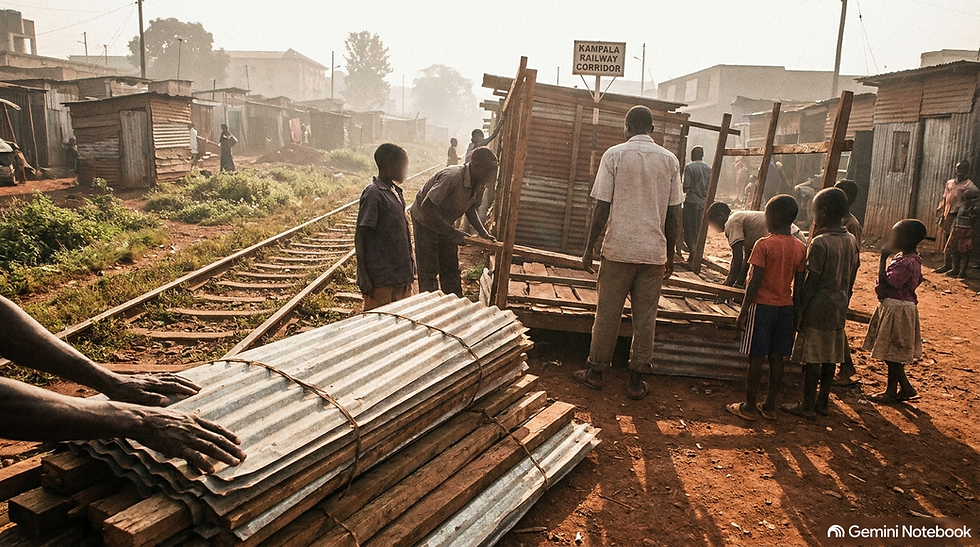
Before heavy state excavators even enter the settlements, the air fills with the metallic echo of claw hammers prying nails from corrugated iron. Driven by the agonizing certainty that state bulldozers will crush everything into useless scrap, residents take on the painful task of destroying their own dwellings. Families carefully unbolt timber beams, remove roofing sheets, and stack unbroken bricks by the roadside to salvage whatever basic building materials remain.
This wave of pre-emptive self-demolition reveals a profound local panic: to survive total economic ruin, residents are forced to become the instruments of their own displacement. The crisis falls hardest on tenant families renting single rooms along the tracks. Unlike landlords who can haul away timber and metal roofing to sell or rebuild elsewhere, renters possess nothing to dismantle. When landlords lose their properties and flee, housing deposits vanish, leaving low-income tenants cast out onto the dirt with bundled belongings and facing immediate street homelessness.
The Policy Gap — Zero Compensation for "Encroachers"
The Ugandan government maintains a strict position: because occupants along the disused tracks reside within statutory railway land, they are classified as illegal "encroachers" on public property. As a result, the government enforces a strict zero compensation and zero resettlement policy.
Without financial reimbursement or relocation packages, low-income urban households face severe poverty, warning that removing families without alternative housing forces parents and children onto the streets as beggars. Displaced residents express deep distress that uprooting established communities strips away their basic economic security and upends the future stability of young children.
Section 4: Moving Boundaries — The 15m, 60m, and 100m Boundary Dispute
At the center of the eviction crisis lies an intense dispute over statutory reserve boundaries. For over thirty years, residents operated under an established operational baseline under Section 32 of the URC Act: a 15-meter reserve on either side of the track's center line, forming a 30-meter total corridor. However, during the October 2026 clearance drive, State Minister for Transport Julius Maganda Wandera defended enforcement by citing Physical Planning Act standards requiring a 30-meter buffer on each side—establishing a 60-meter total swath. Furthermore, around railway stations, turning loops, marshalling yards, and SGR sections, URC claimed wider buffers ranging from 50 meters on each side (a 100-meter total corridor).
In dense informal settlements, shifting an enforcement line outward by 15 to 35 meters does not merely trim a porch or garden; it consumes entire homes, pit latrines, and storefronts. Because a house cannot be partially demolished, marking even a fraction of a foundation condemns the entire structure, turning a bureaucratic boundary shift into total homelessness.
This enforcement exposed a profound state contradiction: the left hand methodically issuing legal land titles, while the right hand dispatches bulldozers to tear them down. For over three decades, municipal councils, district land boards, and the Ministry of Lands formally surveyed these neighborhoods beyond the historical 15-meter buffer—issuing genuine freehold and leasehold titles, approving building plans, and collecting property taxes from the very citizens now branded as squatters.
When URC unilaterally widened its boundary, its red eviction paint crossed straight into legally documented private property. During parliamentary floor debates from October 14 to 16, 2026, lawmakers across party lines condemned the executive's actions. Jinja North Division MP Hussein Muyonjo specifically cited prior commitments made by former Works Minister Gen. Edward Katumba Wamala, who had confirmed that the reserve was strictly 15 meters on either side. The state's institutional incoherence became undeniable when Deputy Attorney General Jackson Kafuuzi admitted to the House that he had not reviewed underlying land title registers or cadastral records before enforcement began.
Balancing Infrastructure with Human Dignity
Modernizing disused rail infrastructure is vital for national transit, but the human cost along Kampala's rail corridors reveals the severe consequences of uncoordinated administrative enforcement. Following the intense legislative backlash, Parliament issued a formal directive establishing a 30-day investigation into the eviction drive and boundary expansions. Reconciling national development with fundamental human rights requires transparent governance, proper cadastral verification, and respect for legal property rights.
Going Deeper: Institutional Governance & Accountability
Beyond the immediate human crisis along the tracks, this eviction drive offers a striking case study in how institutional authority operates when detached from administrative accountability. Applying the JROspace ABCDE Model breaks down the state’s five-stage response—tracing how agencies moved from asserting statutory ownership (Stage A) and rejecting legal obligations to titleholders (Stage B), to disowning the economic fallout (Stage C), facing parliamentary pushback over unverified boundaries (Stage D), and ultimately insulating enforcement behind security directives (Stage E). To examine how this five-stage framework maps directly onto the legal, political, and bureaucratic dynamics of the Kampala clearance drive, read our full Analytical Case Study: Applying the JROspace ABCDE Model to the Uganda Railway Corridor Evictions.
More sources on this story
Railway Land Evictions to Start Nationwide on October 12, URC Warns (Nile Post)
URL: https://nilepost.co.ug/news/376369/railway-land-evictions-to-start-nationwide-on-october-12-urc-warns
Summary & Key Findings: Records URC's advance warning issued on October 7, 2026, announcing nationwide clearances starting October 12 across major lines including Kampala–Kasese, Jinja–Malaba, and Tororo–Gulu–Pakwach. Outlines URC's strict directives regarding structure demolitions, title cancellations, and legal prosecution for non-compliance.
Analytical Utility: Establishes the official timeline, advance public warnings, and statutory enforcement measures announced by URC.
Uganda: URC Starts Demolishing Structures to Reclaim Railway Reserve (AllAfrica / The Independent)
Summary & Key Findings: Reports on excavator demolitions and heavy security deployment in Masanda Village, Kyengera Town Council. Quotes URC spokesperson John Lenonn Ssengendo confirming right-of-way clearance for the Standard Gauge Railway (SGR) western line. Documents resident claims regarding unfulfilled compensation promises from 2022.
Analytical Utility: Captures field enforcement actions, anti-riot security presence, and official agency justifications regarding long-term SGR infrastructure expansion.
Uganda: Works Minister Insists on Evictions of Railway Line Encroachers Despite Concerns by MPs (Pan African Visions)
URL: https://panafricanvisions.com/2026/10/uganda-works-ministers-insists-on-evictions-of-railway-line-encroachers-despite-concerns-by-members-of-parliament-mps/
Summary & Key Findings: Documents the parliamentary session on October 14, 2026, where Works Minister Fred Byamukama defended clearing 9,823 acres of reserve land across 28,486 identified encroachment cases. Details pushback from Jinja North MP Hussein Muyonjo citing former Works Minister Gen. Katumba Wamala's 15-meter promise, resulting in Speaker Oboth Oboth launching a 30-day parliamentary investigation.
Analytical Utility: Documents the parliamentary floor debate, total acreage figures, and the formal legislative directive establishing a 30-day inquiry into boundary expansions.
Uganda Railways Corporation Starts Eviction of Encroachers (NTV Uganda)
Summary & Key Findings: Field footage capturing community anxiety and disruptions to local educational institutions along the rail corridor ahead of national examinations.
Analytical Utility: Illustrates the social cost on youth and education, showing how sudden displacement affects school preparations and family stability.


Comments