The Law of the King: Why Old Testament Covenantal Law Forbids Unaccountable Power
Part 1 of 3: The Old Testament Foundation (~67% Canonical Weight)
BLOG SERIES OVERVIEW & METADATA
• Target Keywords: Biblical leadership, covenant law, authority and accountability, Old Testament ethics, Law of the King, Ezekiel 34, prophetic accountability.
• Series Context: This post is Part 1 of a 3-part web series examining the scriptural inseparability of authority and accountability across the biblical canon. Part 1 establishes the Old Testament legal framework (~67% canonical weight).
• Core Thesis: In Old Testament canonical law, divine authority is never an absolute or unchallengeable privilege. Human power is granted strictly within a conditional legal covenant (b'rit) bound by explicit moral commands (tamim, tzedakah). Unaccountable power automatically triggers built-in covenantal curses (qelalot), leading to moral forfeiture and institutional collapse.
1. The Covenantal Formula: Authority as a Leased Fiduciary Trust
Across the Old Testament scriptures, human authority is never autonomous, self-justifying, or intrinsically possessed. Rulers, monarchs, and judges do not hold inherent power; rather, political and judicial authority is leased as a conditional fiduciary trust. Within the legal architecture of the Old Testament—which comprises approximately two-thirds of the biblical canon—governing legitimacy is strictly bound to a clear operational formula: Authority → Obligation → Consequence.
This architecture is anchored in four foundational Hebrew terms that establish the non-negotiable boundaries of legitimate governance:
B'rit (בְּרִית — Covenant): The overarching legal structure through which God grants authority. Under a covenantal agreement, standing, blessing, and governing rights are strictly contingent upon reciprocal ethical compliance and statutory adherence (Genesis 17:1; Exodus 19:5). Authority divorced from covenantal obligation converts legitimate leadership into an unsanctioned assertion of self-will.
Tamim (תָּמִים — Blameless Integrity): The non-negotiable moral requirement for leaders. When God initiates the covenant with Abraham in Genesis 17:1, the charge is explicit: 'Walk before me and be blameless [tamim].' Moral blamelessness is not an optional character trait; it is a legal prerequisite for holding covenantal standing.
Tzedakah (צְדָקָה — Mandatory Justice): The active ethical duty owed to others, particularly constituents and vulnerable populations. Unlike voluntary philanthropy, tzedakah represents an inexorable legal obligation to execute systemic equity and protect the marginalized (Amos 5:24). Rejection of tzedakah constitutes a direct breach of statutory duty.
Qelalot (קְלָלוֹת — Covenantal Curses): The built-in structural consequences that trigger when ethical duty is abandoned. As codified in Deuteronomy 28, blessings (berakot) automatically follow upright compliance, whereas qelalot execute structural ruin, loss of divine protection, and administrative deposition when power becomes corrupt.
2. Statutory Boundaries: Deuteronomy 17 and 'The Law of the King'
One of the most remarkable legal innovations in ancient near-eastern literature is found in Deuteronomy 17:14–20, known as the statutory 'Law of the King.' While surrounding ancient empires viewed monarchs as living gods or absolute, unreviewable sovereigns, the Hebrew Torah constructed strict constitutional limits around monarchical authority.
Under Deuteronomy 17, the Hebrew king was subject to four explicit statutory restrictions:1. Subjection to Written Law: The king was required to write a personal copy of the Torah and read it every day of his life to remain in strict subjection to statutory law.2. Prohibition of Excessive Wealth: The king was explicitly forbidden from accumulating vast personal wealth or silver and gold.3. Prohibition of Military & Political Expansionism: The king was barred from multiplying horses or returning the nation to Egypt for military leverage.4. Mandatory Humility: The statutory code commanded that the king's heart must 'not be lifted up above his brethren,' establishing that political leaders remain fellow citizens under God's law.
High office in the Old Testament never grants immunity—it multiplies obligation. Elevated position automatically expands the required degree of legal and moral compliance.
3. Prophetic Enforcement: Real-World Case Studies of Power Without Accountability
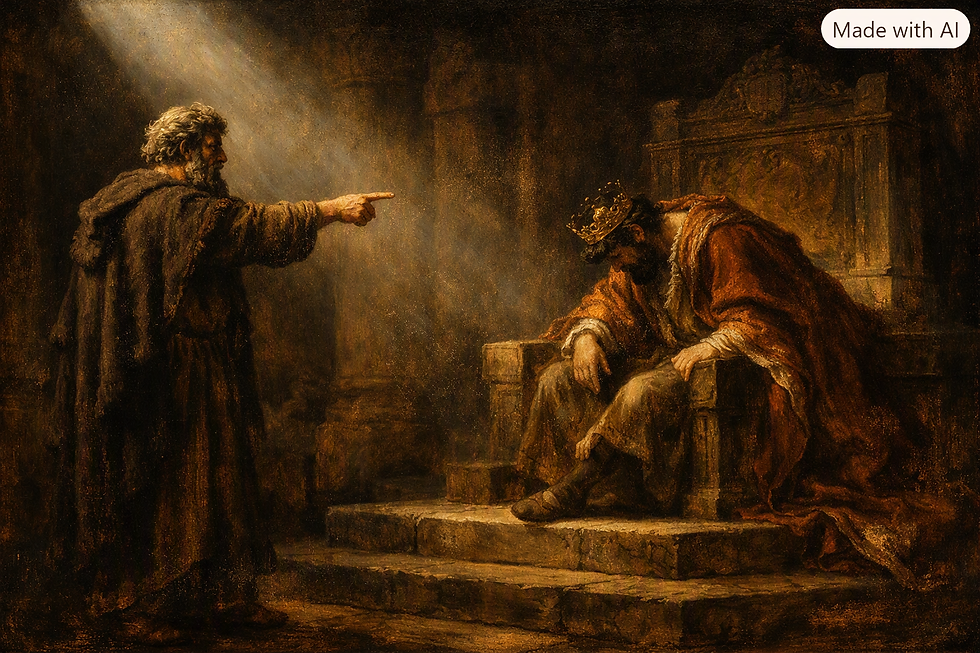
Because human rulers naturally drift toward self-aggrandizement, the Old Testament framework institutes the prophetic tradition as an external statutory enforcement agent. Prophets were not mere predictors of the future; they functioned as covenantal prosecutors who confronted sovereign leaders whenever power was abused.
The following table details the major Old Testament case studies where rulers attempted to exercise unaccountable authority, outlining the exact covenantal mechanism and structural consequence:
Leader / Entity | Claimed Authority | Unaccountable Action | Structural Consequence (Qelalot) |
King Saul | Anointed Monarch | Substituted religious ritual for exact obedience (1 Sam 15:22). | Divine Revocation & Deposition: Stripping of royal authority and loss of kingdom. |
King David | Executive Monarch | Abused state power for adultery, murder, and cover-up (2 Sam 12). | Public Exposure & Perpetual War: Prophetic confrontation by Nathan; relentless warfare. |
King Ahab | Crown Monarchy | Deployed state judicial machinery to execute Naboth & seize land (1 Kings 21). | Dynastic Extinction: Prophetic sentence by Elijah resulting in total destruction of house. |
Ezekiel's Shepherds | Institutional / Pastoral | Exploited constituents for personal enrichment while neglecting weak (Ezek 34). | Forfeiture of Office: Divine revocation of governing rights and rescue of flock. |
Moses | Supreme Lawgiver | Disobeyed explicit divine mandate in public duties at Meribah (Num 20). | Immediate Administrative Judgment: Barred from entering Promised Land. |
Judges-Era Israel | Covenantal Nation | Rejected baseline moral and statutory duties (Judges 2). | Societal Collapse & Subjugation: Systemic internal anarchy and foreign conquest. |
King Uzziah | Executive Monarch | Overstepped statutory boundaries into sacred priestly office (2 Chron 26). | Instant Disqualification: Afflicted with leprosy and forced lifetime isolation. |
These case studies demonstrate three universal principles of Old Testament governance:
1. No Rank Grants Immunity: Even Moses (the lawgiver) and David (the anointed king) faced immediate, unyielding consequences when breaching statutory boundaries.
2. Ritual Cannot Substitute for Obedience: King Saul's attempt to replace moral compliance with ceremonial sacrifice was explicitly rejected as rebellious self-will (1 Samuel 15:22).
3. Institutional Predation Triggers Removal: Ezekiel 34 establishes that when leaders use their position for self-enrichment rather than protecting constituents, their governing authority is legally and spiritually revoked.
4. Key Takeaways & Looking Ahead to Part 2
The Old Testament foundation establishes an unyielding baseline: authority without accountability is structurally impossible. Any human actor or institution claiming divine or moral authority while evading statutory accountability, rejecting obligation, or exploiting the vulnerable automatically forfeits legitimacy.
CONTINUE READING — PART 2 OF THE 3-PART SERIES
📖 Read Part 2 on Ride Da Tiger: 🔗 https://www.ridedatiger.com/single-post/servants-not-sovereigns-how-jesus-subverts-unaccountable-authority
Coming Up in Part 2: Servants, Not Sovereigns: How Jesus Subverts Unaccountable Authority
In Part 2, we explore how Jesus takes this Old Testament legal baseline and escalates it through His Red-Letter teachings (~33% canonical weight). We will examine how Christ redefines leadership from hierarchical dominance to servant stewardship (diakonia and oikonomia), delivers the scathing 'Seven Woes' against Pharisaic hypocrisy, and establishes the rule of proportional accountability (Luke 12:48) under an unavoidable divine audit (krisis).
READ THE COMPLETE APPENDIX X — PART 2 OF THE 3-PART SERIES
Appendix X: 2/3 OT 1/3 NT Analysis of Authority and Accountability from Christianity
Methodological Overview & Canonical Ratio
This document examines the foundational scriptural framework establishing that within Judeo-Christian theology, authority and moral/procedural accountability are structurally inseparable. Any assertion of authority that rejects ethical obligation, verification, or stewardship is treated throughout the biblical canon as structurally illegitimate, hypocritical, and subject to collapse.The biblical distribution follows a precise 2:1 canonical ratio (67% Old Testament / 33% New Testament Red Letters):• Part I: Old Testament Canonical Law, Prophets, and Kings (~67% Draw): Establishes the foundational covenantal architecture (Authority → Obligation → Consequence), statutory limits on royal power, and prophetic mandates requiring leaders to produce justice (tzedakah) and protect vulnerable populations.• Part II: New Testament & Jesus' Red-Letter Teachings (~33% Draw): Escalates covenantal accountability by redefining authority as servant stewardship (diakonia / oikonomia), explicitly condemning hypocritical figures who claim power while rejecting duty, and establishing final judgment metrics (krisis) based on treatment of the vulnerable.


Comments